
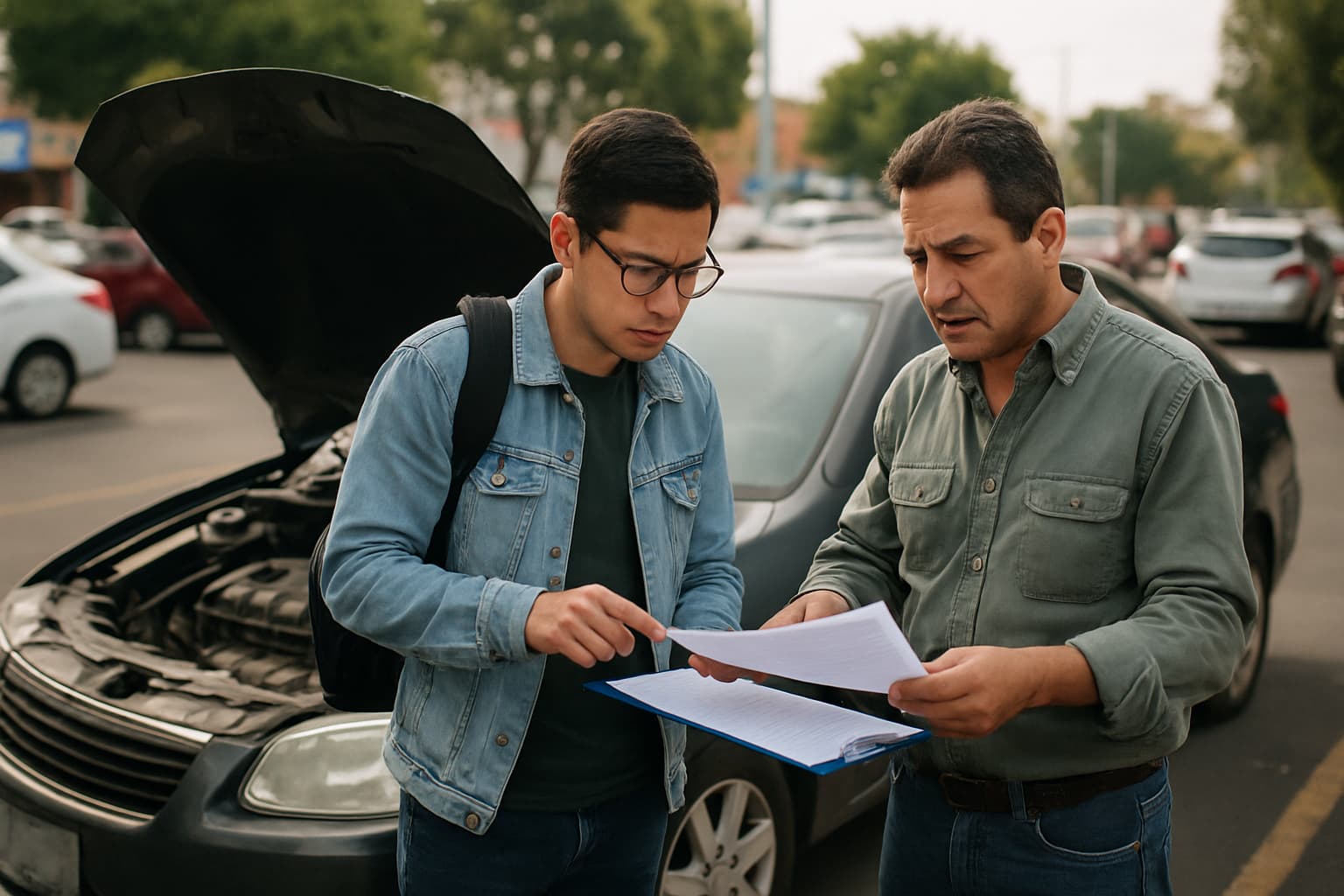

If a Facebook Marketplace listing has a price that looks far too low, polished stock-style photos, and a seller asking for a deposit before you even see the car, walk away. The safest way to buy is to filter the listing first, verify the seller and documents in your first messages, check the car's legal status, and only pay when everything matches.
Marketplace is useful because it gives you a lot of inventory quickly. It is also convenient for people trying to hide paperwork problems, move a car they do not legally control, or collect deposits for a vehicle they do not even have. That is why you need a process, not just good luck.
How to filter suspicious listings before you message
Many scams can be spotted before the first call. None of these signs proves fraud by itself, but each one is a reason to slow down and verify more carefully.
| Red flag | What to check | Why it matters |
|---|---|---|
| Price far below the market | Compare similar cars by year, trim, mileage, and area | Scammers often use a bargain price to rush you |
| Stolen or overly polished photos | See whether the pictures look like dealer photos, foreign listings, or mismatched locations | The listing may be copied just to collect deposits |
| New or empty profile | Look at account age, activity, friends, and whether it seems like a real person | Disposable profiles are common in scams |
| Vague description | Check whether it avoids basics like trim, mileage, paperwork, or service history | The seller may not know the car or may be hiding issues |
| Extreme urgency | Phrases like “first transfer takes it today” | The goal is to make you pay before checking anything |
| Confusing location | The ad says one city, but the profile, plates, or answers point somewhere else | This is common in recycled ads and questionable middleman sales |
How to review the photos in two minutes
- Make sure all photos show the same vehicle in a consistent setting. Different wheels, different interior color, or different plates are a bad sign.
- Ask for fresh photos taken that day, including the front, one side, and the dashboard with the ignition on. If the seller cannot send them, they may not have the car.
- Request a photo of the VIN/NIV visible on the windshield or door jamb and another of the odometer. Refusing without a clear reason is a red flag.
If you want more patterns to watch for, this guide to common used-car scams covers many of the same tricks that show up on Marketplace.
Your first-contact protocol with the seller
Your goal is not to lock the car down fast. Your goal is to confirm that the car exists, that the seller has a real relationship to it, and that they are comfortable with normal checks.
- Ask for specific details. Year, trim, mileage, how long they have owned it, why they are selling, and whether there are any pending debts or ownership-transfer issues.
- Ask whose name the car is in. If the answer is “my uncle's,” “my cousin's,” or “I am helping sell it,” be more careful from that point on.
- Request the VIN/NIV and document photos. You do not need every private detail uncovered, but you do need enough to compare the name, serial number, model, and plates.
- Ask whether they accept legal and mechanical inspection. A legitimate seller usually does not get offended when you want to check REPUVE, the VIN, the paperwork, and the car itself.
- Ask how payment would work. If the answer is a deposit to reserve it, a transfer to someone else's account, or a rushed handoff with paperwork “later,” stop there.
Questions worth asking right away
- Is the factura in the name of the person who will sell and sign?
- Does the registration card (tarjeta de circulación) match the current plates?
- Do you have service records, inspections, or recent receipts?
- Are you okay with a mechanic or independent inspection?
- Are you okay with a REPUVE check before meeting?
Conversation red flags
- The seller insists on a transfer so nobody else gets the car.
- They refuse to share the VIN or a current photo.
- They avoid direct answers and only send voice notes.
- They want payment sent to a third party.
- They say the paperwork can be fixed later or “that part is easy.”
Where to meet the seller safely
Your first meeting should not be at night or in an isolated place. The safest setup is daylight, a busy public location, working phone signal, and ideally cameras around.
- Bring another person with you. Even if you know cars, a second set of eyes helps you spot inconsistencies and avoid being isolated.
- Share your live location and schedule with someone you trust.
- A good plan is to see the car in a public place first and then take it to a workshop or inspection point you already agreed on.
- Do not hand over your ID or money just to “hold” the car during the first meeting.
- If the seller keeps changing the meeting point or sends you somewhere vague, cancel.
Also watch whether the seller's story matches their behavior. If they claim they have owned the car for years but do not know basic details, cannot open the hood, or someone else suddenly shows up to negotiate, take that seriously.
How to pay with less risk
The most useful rule is simple: do not pay before you verify the car, the seller, and the documents. Safe payment starts with refusing shortcuts.
| Payment method | Risk | Recommendation |
|---|---|---|
| Deposit to reserve the car | Very high if you have not seen the car and paperwork | Avoid it |
| Transfer to a third-party account | Very high | Do not do it |
| Cash | Security risk and weak traceability | Only in a very controlled, documented situation |
| Bank transfer between buyer and actual seller | Lower, if everything has already been verified | Usually the cleanest option |
A practical payment sequence
- Inspect the car and compare it with the listing.
- Verify the seller's identity and the paperwork.
- Check the vehicle's legal status before moving money.
- Pay only when the seller is present and ready to sign the sale documents and hand over keys and paperwork.
- Confirm that the receiving bank account matches the seller or is supported by a clear documented explanation.
If you absolutely must leave a small deposit, do it only after confirming that the car is real, the documents make sense, and there is a signed receipt. Even then, on Marketplace it is usually safer to skip the deposit and move on if the seller pushes too hard.
Minimum legal checks before you pay
Before you close the deal, check the car in REPUVE using the plates or VIN/NIV. You can use the REPUVE lookup and the official government guidance on the legal status consultation in REPUVE. If you want the step-by-step process, this guide on checking REPUVE before buying helps you interpret the result.
A clean REPUVE result is useful, but it is not the whole story. You should still compare the VIN/NIV in at least these places:
- The visible VIN on the vehicle
- The door-jamb label or plate
- The factura or refactura
- The registration card (tarjeta de circulación)
If the number changes between documents or looks physically altered on the car, stop the purchase. The same applies if the seller cannot clearly explain why the name on the factura, the registration card, and their ID do not match.
Ownership-transfer requirements and fees change by state and over time. Always check the local authority before signing anything. In Mexico City, for example, the official reference is the SEMOVI ownership transfer process.
A safer Marketplace buying route
- Reject listings with unrealistic prices, suspicious photos, or sketchy profiles.
- Before leaving home, get the VIN, fresh photos, and the seller's basic story.
- Run the REPUVE check and compare the VIN with the paperwork.
- Meet during the day in a public place and bring someone with you.
- Take the car for a mechanical inspection or independent review.
- Only then agree on payment and signed sale documents.
- Complete the ownership transfer as soon as possible.
The best Marketplace purchase is not the one that looks cheapest. It is the one that survives questions, accepts inspection, and does not need to rush you.
Frequently asked questions
Is it safe to send a deposit to hold a car on Facebook Marketplace?
Usually no. If you have not seen the car, checked the paperwork, and confirmed who actually controls the vehicle, the risk is high. When a seller pushes for an immediate transfer, it is often better to let that car go.
What if the seller says the car is in someone else's name?
That does not automatically mean fraud, but it does mean more paperwork and more risk. You need to understand the ownership chain and confirm that the person signing really has the right to sell. If the explanation stays blurry, walk away.
Does a clean REPUVE record mean the car is safe to buy?
No. REPUVE is an important legal check, but it does not replace matching the VIN, reviewing the factura and registration card, checking local debts, and inspecting the car mechanically. Treat it as one layer of verification, not final approval.
Should I buy from a brand-new seller profile if the car looks good?
A new profile does not prove fraud, but it raises the risk. If it also comes with a bargain price, refusal to share the VIN, or pressure to transfer money, you are better off finding another option. On Marketplace, consistency matters more than appearance.
Where should the final payment happen?
The cleanest option is usually after the car, seller, and documents have already been verified, with both parties present in a safe setting and the paperwork ready to sign. Avoid handing over cash in improvised places or making a hurried transfer from inside the car.
If you already found a car, you can inspect it with AutoBuddy using photos of the vehicle and its documents, plus a free REPUVE check before you decide.